
Most people think marigolds mean joy and sunshine.
That is the easy answer.
But put the same golden flower in a different place, and the meaning changes fast.
On a wedding garland, marigold can feel like blessing and abundance. On a grave, it can become remembrance. On a Día de Muertos petal path, it becomes welcome. In an old calendula entry, it can even point toward grief.
That is the surprise: marigold meaning is not one message. It depends on the plant, the culture, and where the flower is placed.
Here are seven marigold meanings that go beyond "joy and sunshine" and make the flower much more interesting.
The First Surprise: Meaning Changes By Placement
Marigold is a placement flower.
On the ground, it can become a path. On an altar, welcome. On a grave, remembrance. In a garland, celebration. In calendula flower language, grief. In wallpaper, rhythm.
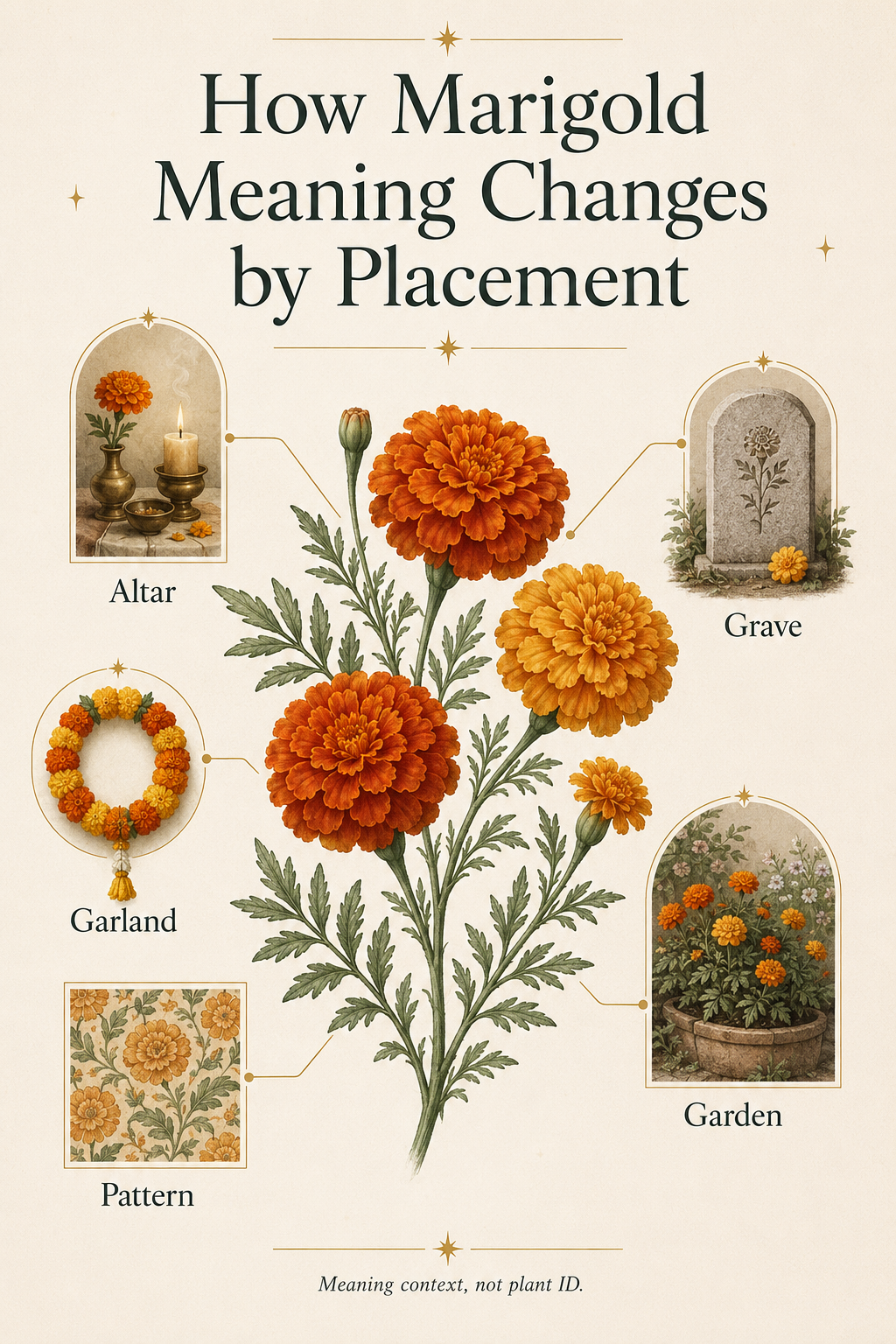
The petals do not carry one universal message by themselves. People give the flower context, and context changes the meaning.
That is why marigold can feel joyful and mournful at the same time. It is not confused. It is answering different rooms.
Marigold is gold with memory in it.
First, Which Marigold Do You Mean?
Before marigold can mean anything clearly, we have to know which flower is being named.
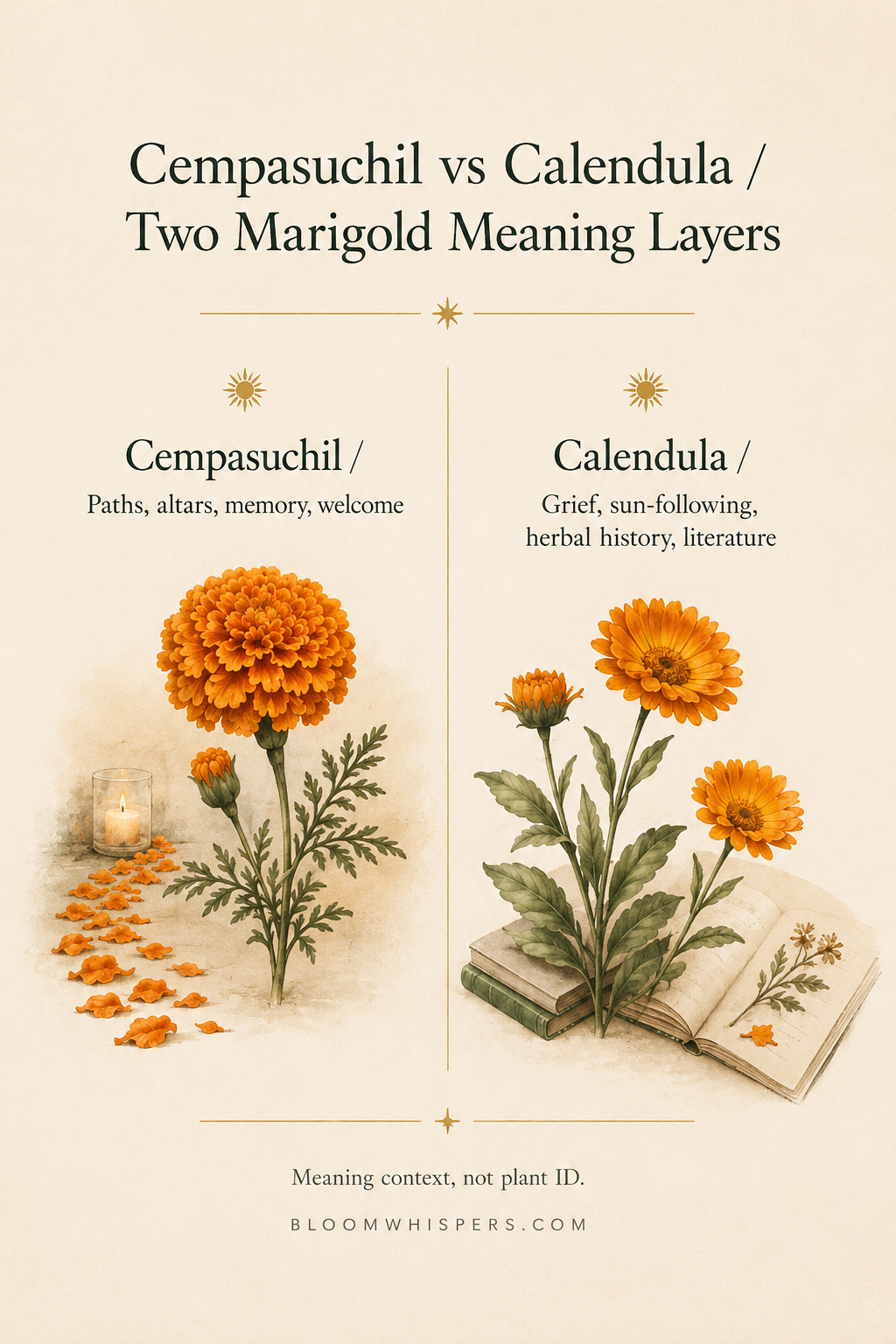
The common name gathers several golden flowers under one bright umbrella. That is where meaning gets messy. One article borrows grief from calendula, Día de Muertos from cempasúchil, wedding color from Tagetes, and herbal history from old European sources, then makes it sound like every marigold means everything.
Marigold deserves a cleaner map.
If you like this kind of plant-name cleanup, the same problem shows up in spider lily colors and meanings, where color can point to a different plant.
Cempasúchil / Mexican Marigold (Tagetes erecta)
Cempasúchil is the marigold most tied to Día de Muertos. The main botanical anchor for that story is Tagetes erecta, also called Mexican marigold or Aztec marigold in English-language contexts.
Kew Plants of the World Online accepts Tagetes erecta and gives its native range as Mexico to Guatemala. Mexican institutional and academic sources connect cempasúchil with sun, scent, altars, paths, graves, offerings, and the return of the dead.
If someone is asking about the "Day of the Dead marigold," this is usually the flower-story they are looking for.
Calendula / Pot Marigold (Calendula officinalis)
Calendula is also called pot marigold or garden marigold, but it is not cempasúchil.
It is Calendula officinalis, a separate plant. This is the marigold that often appears in European herbals, older flower-language books, culinary references, and Shakespearean discussions.
That matters because calendula can carry grief and sun-following symbolism without proving that Mexican cempasúchil means the same thing in the same way.
French And African Marigolds
"French marigold" often refers to Tagetes patula. "African marigold" is a horticultural common name often applied to Tagetes erecta.
The useful correction: "African marigold" does not mean the species is native to Africa. For Tagetes erecta, the botanical source used here points to Mexico and Guatemala.
Common names travel. Sometimes they bring beauty. Sometimes they bring confusion.
Cempasúchil Meaning In Mexico
Cempasúchil is where marigold stops being a color and becomes a path.
In Mexico, cempasúchil belongs to Día de Muertos: home altars, graves, tombs, patios, candles, food offerings, copal smoke, prayers, family memory, and the hope of return.
This is why the flower feels so charged. It gives remembrance a color, a scent, and a route.
The Name Means "Twenty Flowers" Or "Many Flowers"
The name cempasúchil comes through Nahuatl-linked forms such as cempoalxóchitl or cempohualxochitl. INAH gives the short Spanish phrase "veinte flores," and the name is commonly interpreted as "twenty flowers" or "many flowers."
The name already feels full.
Many petals. Many flowers. Many returns.
Why Color And Scent Matter
With cempasúchil, beauty has a job.
INAH describes the petals as part of the path or offering that guides souls, while the aroma helps guide their arrival. That makes the meaning beautifully practical. Memory is not left floating in the air. It is placed, petal by petal.
The flower does not whisper from a vase.
It points.
Paths, Altars, Graves, And Return
Cempasúchil belongs to the threshold: home and elsewhere, table and path, living and dead.
In Día de Muertos contexts described by the sources, flowers can appear on home altars, graveyards, tombs, patios, paths, and offerings. They are part of a larger welcome that may include food, candles, copal, holy water, prayer, and community gathering.
INAH frames the flower within a life-and-death cycle, saying "vida y muerte forman parte de un mismo ciclo." In English: life and death are part of the same cycle.
That is why cempasúchil feels different from a generic sympathy flower.
It says more than "I miss you."
It says, "I prepared a place for you."
For another flower where grief, season, and thresholds meet, read red spider lily symbolism.
The Meaning Is Cultivated
The easy story would be: ancient flower, unchanged ritual, simple symbolism.
The real story is better.
ASyD describes modern Día de Muertos cempasúchil use as a living, syncretic practice shaped by Indigenous plant knowledge, Catholic calendar timing, planting schedules, flowering time, harvest, regional conditions, and community care.
In other words: the meaning is cultivated.
People plant for the date. They time the bloom. They harvest, carry, scatter, arrange, and remember.
The flower becomes ritual gold because human hands keep making it so.
Marigold Symbolism By Culture And Occasion
Marigold keeps returning to a few big ideas: sun, threshold, devotion, memory, public beauty, and welcome.
But each culture and occasion gives those ideas a different shape.
Mexico: Remembrance, Return, Sun, Life And Death
In the Mexican cempasúchil layer, marigold means return, memory, sun, scent, graves, altars, life, death, and the care of welcoming loved ones home.
This is the emotional center of the article because it is the strongest source-backed meaning layer for Tagetes erecta.
South Asian Weddings And Ceremonies: Auspiciousness And Celebration
The UCL/JTCM source notes Tagetes erecta in India in contexts such as Ganesh Chaturthi and weddings, with associations of prosperity and auspiciousness.
Here the gold turns festive: blessing, welcome, devotion, abundance, and public joy.
For wedding decor, marigolds work because they are impossible to ignore in a good way. A marigold wedding table or centerpiece can feel warm, visible, and abundant, especially through garlands, low vessels, orange-yellow clusters, or entrance flowers.
This overview keeps the South Asian layer brief because a dedicated wedding article should use stronger country-specific sources before expanding the cultural detail.
Nepal / Tihar: Light, Color, And Garland Context
The source set also connects Tagetes erecta with Nepal during Tihar, and the Nepal Tourism Board supports Tihar as a five-day festival of lights and colors, with homes decorated with lights and garlands.
For this overview, the safe point is simple: marigold appears in festival-garland contexts beyond Mexico, where its meaning can turn toward light, honoring, devotion, and celebration.
China / Qingming: Remembrance And Honoring
The UCL/JTCM source notes marigold use in China during Qingming to honor the deceased or divine.
That creates a quiet bridge with the Mexican layer: gold placed near remembrance. Because this article does not yet have a deep country-specific source for China, this remains a brief bridge rather than a full cultural guide.
Europe: Calendula, Grief, And The Sun
In European literary and flower-language contexts, "marigold" often means calendula or pot marigold.
This is where the grief layer appears most clearly. Henrietta Dumont's public-domain flower-language book connects marigold with grief, and the Shakespeare Birthplace Trust frames Shakespeare's marigold as calendula, a flower tied to both sun-following imagery and mourning or grave contexts.
So marigold has never been only cheerful.
Even in old flower-language books, the gold could darken.
Marigold In Literature And Art
Marigold also has a design life.
Writers and makers return to it because it behaves like sunlight with structure: opening, following, repeating, turning, holding a room.
Shakespeare's Sun-Following Marigold
The Shakespeare Birthplace Trust frames Shakespeare's marigold as calendula. In that literary layer, marigold becomes a sun-clock flower: opening, closing, and following the light.
That sun-following image belongs with calendula, not cempasúchil. But it still deepens the broader marigold family of meanings. This flower keeps looking toward light, even when the story turns toward mourning.
Marigold In Flower-Language Books
Older flower-language books can be charming, strange, and inconsistent. They should not be treated as universal truth.
For marigold, the European grief layer is still useful because it keeps the flower from becoming a flat symbol of cheer. Calendula can carry grief, distress, remembrance, and the mixedness of life.
That is one room in the marigold house, not the whole house.
William Morris's Marigold Wallpaper
William Morris gives marigold an afterlife in pattern.
The Cleveland Museum of Art describes Morris's "Marigold" as one of his early designs for printed fabric, originally intended for wallpaper and later available in multiple materials. The Met records a Morris & Co. "Marigold" wallpaper dated 1875, block-printed in distemper colors.
This is design history, not proof of ancient flower symbolism.
Its value is different: it shows how a flower becomes something people want to live with.
The Cleveland Museum's phrase "ordered freedom" belongs here. Morris's marigold is growth given rhythm. Vines move, blossoms repeat, and the room receives a kind of disciplined sunlight.
For modern readers, that opens a beautiful design lane: marigold wallpaper, art prints, embroidery, stained glass, textile patterns, and phone backgrounds. The flower can become rhythm as well as bouquet.
Marigold Uses, Recipes, And Benefits: What To Treat Carefully
Marigold has real use history. It also has a noisy internet life: benefits, tea, oil, recipes, jelly, magical properties, herbal uses, supplements.
The safe answer is short.
Historical Use Is Not A How-To
The UCL/JTCM source follows Tagetes erecta from historical and traditional contexts into modern scientific, pharmaceutical, feed, supplement, and industrial interest.
That history is real. It is not a recommendation.
A plant being studied does not mean a reader should ingest it, dose it, apply it, buy it as a supplement, or use it as treatment.
Recipes Depend On The Plant
Calendula / pot marigold appears in historical food and herbal contexts. Cempasúchil also has Mexican culinary research potential.
One UNICACH university repository record points toward Mexican culinary research on cempasúchil, but only the record or abstract was read for this pass. This article does not give cempasúchil recipes.
For another Bloom Whispers meaning guide that keeps beauty and warning together, read Queen Anne's lace meaning.
Magical Properties Need Care Too
Marigold magical properties can be discussed as folklore, ritual mood, symbolic reflection, and cultural meaning. They should not be presented as factual metaphysical claims.
The safest symbolic language is also the most beautiful: marigold can be an image of memory, warmth, devotion, threshold, and meaningful brightness.
Marigold-Inspired Decor, Gifts, And Wedding Ideas
Marigold works in decor because it has a strong visual identity: altar gold, wedding garland, festival color, wallpaper vine, textile pattern, flower tattoo, garden pot, and harvest table.
The key is to choose the right story for the right use.
For Remembrance And Cempasúchil Decor
Cempasúchil art, paper flowers, altar prints, and educational decor can be beautiful when framed respectfully.
Do not flatten Día de Muertos into a spooky orange aesthetic. Cempasúchil belongs to remembrance, welcome, family, food, light, scent, and the life/death cycle.
For Weddings And Tables
Marigold garlands, centerpieces, entrance flowers, and warm yellow-orange arrangements can make a wedding space feel abundant before anyone reads a word.
In South Asian wedding contexts, the source set supports auspiciousness, prosperity, devotion, and celebration. In broader wedding design, marigold can bring warmth, abundance, and bold golden color.
For Wallpaper, Pattern, And Art
William Morris's "Marigold" gives design lovers a museum-backed bridge into wallpaper, textile, print, and pattern.
Here marigold means rhythm: gold against green, vine against wall, repeated blossom, order with movement.
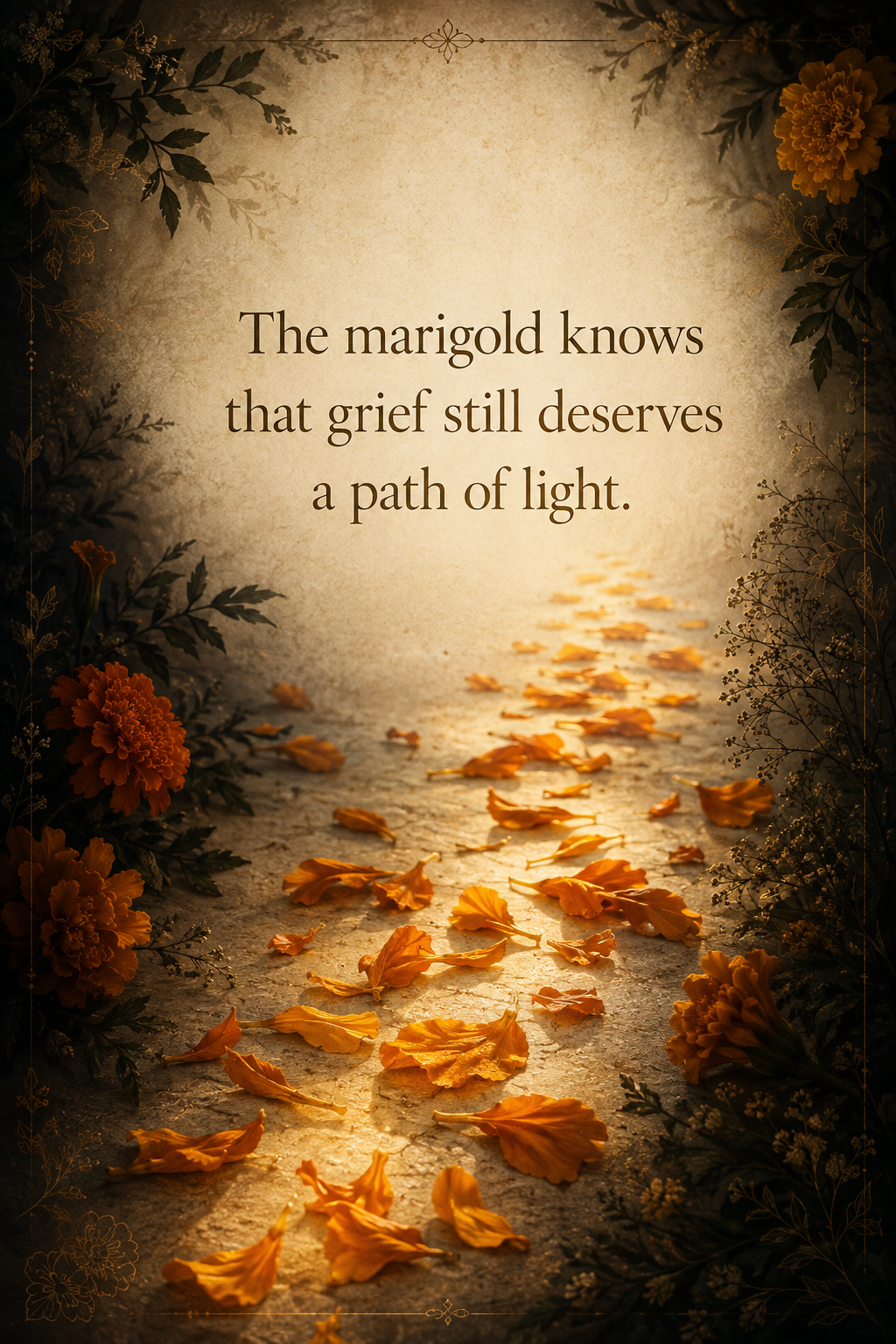
Bloom Wisdom: Our Interpretation
Our interpretation: marigold teaches placement.
The same gold can sit on an altar, a grave, a wedding garland, a temple doorway, a wallpaper, or a page in a flower-language book. It does not become meaningless because it changes. It becomes more human.
Marigold's wisdom is not "be bright."
It is: know where your brightness belongs.
Some gold is for celebration. Some gold is for memory. Some gold is for devotion. Some gold is for the doorway. Some gold is for the pattern that steadies a room.
Marigold reminds us that beauty can blaze and still be tender.
Three Safe Ways To Bring Marigold Into Your Life
These are non-medical, non-foraging, non-recipe ideas inspired by the research and symbolism.
1. Remembrance
Use marigold imagery, art, or flowers as a warm symbol of memory.
That might mean a print, a golden arrangement, a journal page, or a small seasonal object that says: I can miss you and still make a place bright.
If you draw from Día de Muertos imagery, keep it respectful: name cempasúchil, learn the context, and do not reduce the tradition to a costume, spooky mood, or generic Halloween palette.
2. Celebration
Use marigold's gold for thresholds: weddings, entrances, tables, birthdays, harvest gatherings, and places where welcome should feel visible.
A marigold garland or centerpiece says warmth before anyone reads a card.
3. Design
Use marigold as pattern inspiration: wallpaper, textile, embroidery, stained glass, art print, phone background, or color palette.
The Morris lesson is useful here. Marigold does not need to be literal to work. It can become rhythm, vine, repeated blossom, gold against green, order with movement.
Conclusion
Marigold is a flower of many thresholds.
One threshold is an altar path, bright with cempasúchil and memory. One is a wedding doorway hung with garlands. One is a page in an old flower-language book where calendula darkens into grief. One is a wall where William Morris lets the flower repeat until a room feels rooted.
The marigold's gold is not empty decoration.
It is light placed with intention.
Sources And Further Reading
- Kew Plants of the World Online, Tagetes erecta L.: https://powo.science.kew.org/taxon/urn:lsid:ipni.org:names:252092-1
- Kew Plants of the World Online, Calendula officinalis L.: https://powo.science.kew.org/taxon/urn:lsid:ipni.org:names:187894-1/general-information
- CONABIO/EncicloVida, "Cempasúchil (Tagetes erecta)": https://enciclovida.mx/especies/180679.pdf
- INAH, "Cempasúchil y mariposas: símbolos del regreso de las almas": https://www.inah.gob.mx/index.php/foto-del-dia/cempasuchil-y-mariposas-simbolos-del-regreso-de-las-almas
- Serrato-Cruz, "Cultivation methods and cultural motives for growing 'flor de muerto' (Tagetes erecta L.)," Agricultura, Sociedad y Desarrollo: https://www.revista-asyd.org/index.php/asyd/article/download/1339/716
- Lopez Estrada, Chang, and Heinrich, "From 'traditional' to modern medicine: A medical and historical analysis of Tagetes erecta L. (Cempasúchil)," Journal of Traditional and Complementary Medicine, open PDF via UCL: https://discovery.ucl.ac.uk/id/eprint/10203572/1/1-s2.0-S2225411024000920-main.pdf
- UNICACH repository record, "Documentación del uso gastronómico de la Flor de Cempasúchil (Tagetes erecta)" (record/abstract only for this article): https://repositorio.unicach.mx/handle/20.500.12753/4635
- Henrietta Dumont, The Language of Flowers / The Floral Offering, Project Gutenberg: https://www.gutenberg.org/cache/epub/71779/pg71779-images.html
- Shakespeare Birthplace Trust, "Shakespeare's Favourite Flowers: The Marigold": https://www.shakespeare.org.uk/explore-shakespeare/blogs/marigold-on-death-beds-blowing-the-marigold-in-shakespeare-and-victorian-england/
- Cleveland Museum of Art, William Morris "Marigold": https://www.clevelandart.org/art/1937.699
- The Metropolitan Museum of Art, William Morris "Marigold": https://www.metmuseum.org/art/collection/search/384018
- Nepal Tourism Board, Tihar: https://ntb.gov.np/tihar
Frequently Asked Questions
Questions from the garden
What does marigold symbolize?
Marigold can symbolize sun, remembrance, return, grief, devotion, celebration, auspiciousness, welcome, warmth, and beauty placed with intention. Its meaning depends on the plant and context: Mexican cempasúchil, European calendula, wedding garlands, festival flowers, or design motifs.
What does cempasúchil mean?
Cempasúchil is a Nahuatl-linked name commonly interpreted as "twenty flowers" or "many flowers." In Mexico, it is strongly tied to Día de Muertos, where its color and aroma help mark paths, altars, graves, and offerings for loved ones returning in memory and tradition.
Why are marigolds used for Día de Muertos?
In Día de Muertos tradition, cempasúchil petals and scent help guide returning souls or ánimas toward altars and offerings. The flower is also associated with sun, renewal, life, death, and Mexican biocultural heritage.
Are marigolds only for Día de Muertos?
No. Cempasúchil is central to Día de Muertos in Mexico, but marigolds also appear in South Asian weddings and festivals, Nepal's Tihar context, China/Qingming remembrance contexts, European calendula flower language, gardens, art, wallpaper, and modern decor.
Are marigolds used in weddings?
Yes. Marigolds are used in wedding garlands, entrances, mandap and haldi decor, table flowers, centerpieces, and bouquets. In South Asian wedding contexts, research supports associations with prosperity, auspiciousness, devotion, and celebration. In broader wedding decor, marigold often brings warmth, abundance, and bold golden color.
Is marigold a flower of grief?
Sometimes, but not always. Older European flower-language sources can link marigold, likely calendula or pot marigold, with grief and distress. Mexican cempasúchil has a different remembrance layer: it is a flower of return, welcome, sun, scent, altars, and the life/death cycle.
Is calendula the same as marigold?
Calendula is often called pot marigold or garden marigold, but it is not the same as cempasúchil or Tagetes erecta. Calendula is Calendula officinalis, a separate plant that carries many European herbal, literary, food, and floriography references.
Can you eat marigolds?
This article does not give eating, recipe, foraging, or medical advice. Some calendula and marigold traditions include food uses, but the safe answer depends on the exact plant, edible-grade sourcing, and reliable food-safety guidance. Do not use this meaning article as a recipe guide.
What are marigolds used for?
Marigolds are used in rituals, festivals, offerings, graveside remembrance, weddings, garlands, gardens, decor, wallpaper, art, textile patterns, and historical food or herbal contexts. This article treats food and herbal uses as history only, not advice.
Why are marigolds orange or yellow?
Marigolds are known for yellow, orange, and red-orange flower heads. Modern research discusses carotenoid and lutein interest in Tagetes erecta, but this article uses the color mainly as cultural symbolism: gold, sun, warmth, visibility, welcome, and remembrance.
What is the spiritual meaning of marigold?
As symbolism, marigold can suggest memory, return, devotion, celebration, grief, sun, warmth, and thresholds between life and death. Magical or spiritual meanings should be treated as folklore, ritual mood, or personal reflection unless a specific cultural source supports a specific claim. Protection can appear as a secondary symbolic theme, but it should not be treated as the strongest verified meaning here.
What is the difference between French marigold and African marigold?
French marigold usually refers to Tagetes patula. African marigold is a horticultural common name often applied to Tagetes erecta. The name "African marigold" does not mean the species is native to Africa; the botanical source used here gives Mexico to Guatemala as the native range for Tagetes erecta.